

Last week I stumbled upon a Tamil film called Paranthu Po - “Fly Away.”
The setup is painfully ordinary. A middle-class couple in the city, punching above their weight to give their son the best life they can imagine. They work long hours. The boy stays home, locked into online tuitions. Every now and then, the parents remind him how much they love him - ‘look at the tuitions, the toys, the laptop. Look at everything we’ve done for you.’
But all the boy wants is time with his parents. An evening with his dad. A morning with his mom. Just their presence in the home.
The film turns when a casual outing becomes an unplanned road trip, and the father and son end up bonding over learning the meaning of life from each other.
Two decades ago, I would have watched this film as the son. I would have felt seen. I’m 36 now. I watched it as the father. And I saw a version of myself I never want to become.
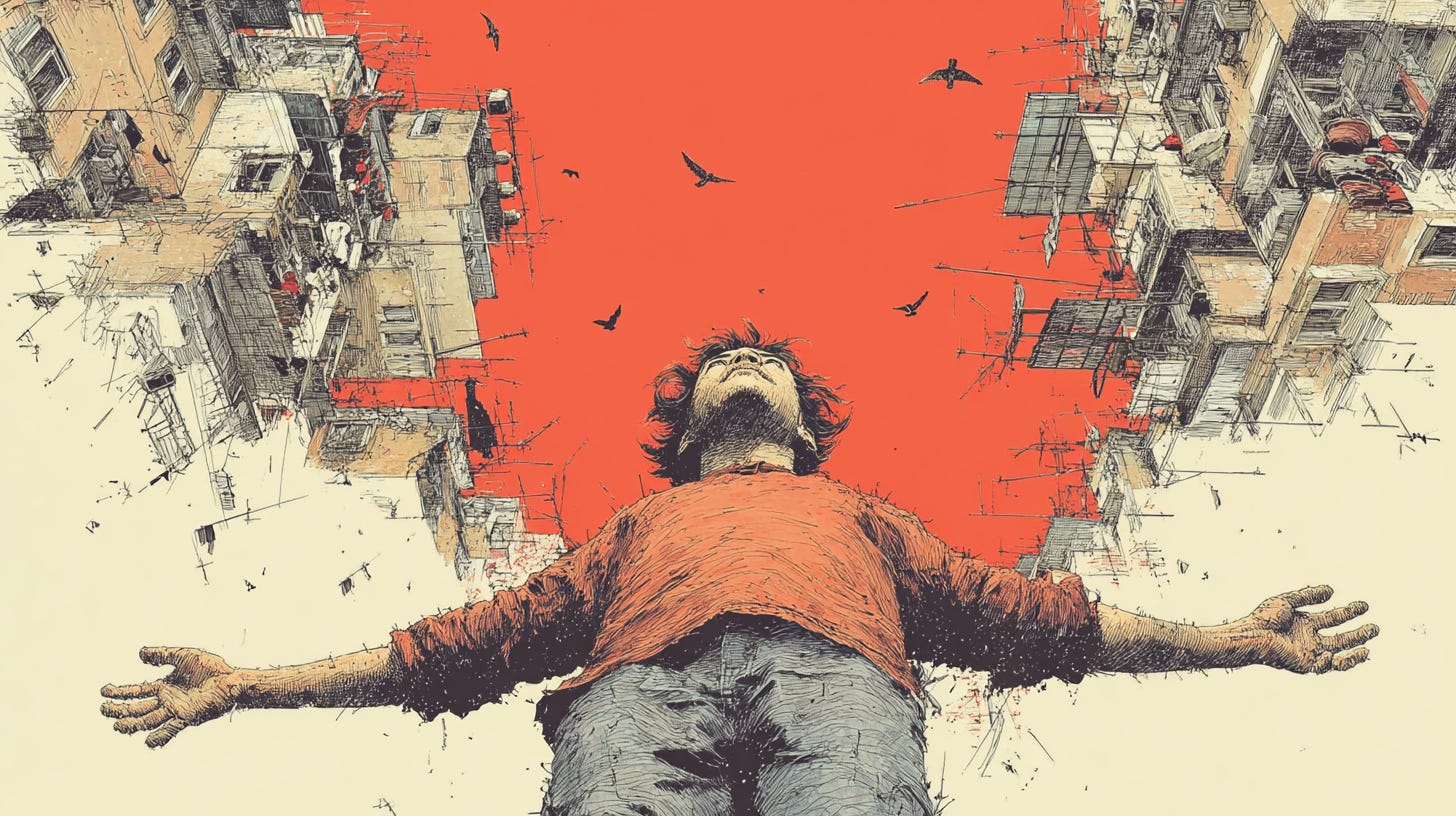
For the last few months, I’ve been burnt out. What’s strange is that nearly everyone I know in the startup world is in the same place. We don’t talk about it much, but the exhaustion is collective, like a shared secret no one wants to name.
Part of it is the narrative the tech industry has perfected: This is a once-in-a-lifetime moment. If you’re not building right now, you’re falling behind. There’s an enormous pressure to stop being a spectator and become a player - to get on the field with dreams of winning the championship. So everyone plays. But the game we signed up for as spectators looks nothing like the game we’re actually playing. The rules change by the hour. The goalposts keep moving. It feels less like a competition and more like Squid Game - where the point isn’t just to win, but to survive.
I was in undergrad when the iPhone launched. I watched the App Store create billion-dollar companies in real time. I was too young for the dot-com boom. I missed the mobile wave. And now, with AI reshaping everything, there’s this deep, almost primal feeling: I cannot miss the bus again.
So I made a deal with myself. Work now, relax later.
That deal sounds reasonable. But here’s what it actually looks like in practice: every family event missed gets justified. Every dinner with friends, skipped. Every movie I wanted to watch, every restaurant I wanted to try - classified “not productive.” I’ve trained my brain to sort the things I love most into a category called waste of time, and the things that has a clear action item like - closing a deal, pitching an investor, hiring, brainstorming - into the only category that feels productive.
The trade felt worth it. Until one morning a few days ago.
My dad called, out of the blue. He said mom wasn’t feeling well and that I should call her. It wasn’t serious. My family has been extraordinarily supportive of my journey - they’ve never placed demands on me, never guilted me about missing things. I speak to my mom a few times a week, maybe. That should have been enough to make me pick up the phone immediately.
Instead, my first thought was: I don’t have space for this today.
Not grief. Not concern. Capacity planning.
When I caught myself, I felt a kind of shame that’s hard to describe. My mother being unwell had been categorized - instantly, reflexively - as one more problem in the queue. I wasn’t hoping she’d feel better because I loved her. I was hoping she’d feel better so I could stop worrying about it.
That same week, someone pinged me about a potential partnership, and I responded within minutes - warm, eager, fully present. My mom had asked me to attend a family wedding, and I’d been sitting on that message for days.
Sometimes I wonder if the journey is worth it.
My parents worked their entire lives under a single promise: Once this is done, we’ll rest.
The milestones kept shifting. First it was my high school - once he clears those, we can breathe. Then college. Then a job. Then a marriage. Each milestone arrived, and the rest never did. Not because life didn’t allow it, but because their brains had forgotten how.
Decades of postponed living had rewired them. Relaxation wasn’t a reward waiting at the finish line. It was a skill they’d lost from disuse.
A few weeks ago, my mom said something that stopped me cold. She said, “I find it extremely strange when there’s no active problem to think about. When everything is calm, I feel like something is fundamentally wrong.”
Her body had been so conditioned by stress that peace felt like a threat.
I know, intuitively, that any journey obsessed only with its destination is not much of a journey at all.
But the destination looks so impossibly large that you never feel like you’re doing enough to reach it. So you look for ways to accelerate. Can I raise more funds? Hire faster? Build more? Talk to more people? Brainstorm harder? Every answer leads to another question, and none of them bring the clarity you’re actually longing for - the feeling that you’ve finally arrived, that your potential has been fully spent.
And then there’s the envy. You look at your peers and think, If they can do it, why can’t I? That thought alone can fuel years of overwork. It can also hollow you out completely. Here’s something I think about actively: you cannot accelerate cooking by turning the flame to its highest. You’ll burn the outside and leave the inside raw. Every journey has its own time. Not every journey is bound for the same destination.
There will be a hundred LLMs that threaten your existence. A thousand startups chasing the same market. A million people chasing the same job. But there is exactly one copy of you in the entire world. And here’s the strange part - the things that make you you are almost never on the checklist. They’re everything outside it. The film you watched on a whim. The road trip you didn’t plan. The book you read on an unexpected evening.
We live in a time where the never-ending checklist has been normalized - where having no whitespace in your day feels like discipline, and having any feels like failure. But you need active effort to break outside of it. You need room for the things that aren’t productive. Because those are the things that make you whole.
Burnout didn’t just make me neglect the people I love. It made me rank them. If I had to say in VC terms, learning to be in the present and being stress free in itself is a moat for life.
<Note to self>
This is such an honest sentiment. Thank you for sharing your thoughts on that! It resonates a lot as I'm literally blocking out me-time or rest-time in the day so I can train myself that rest is productive. And it is. I strongly believe that people make more impact when they do one thing that matters over 10 things that are urgent.
You shared your version, but looking around, I felt you wrote about society